

- - -
-
CHAPTER 22
The silver-haired woman in the van leaned her head against the bulletproof window and closed her eyes. She felt like the world was spinning beneath her. The drugs they’d given her made her feel ill.
I need medical attention, she thought.
Even so, the armed guard beside her had strict orders: her needs were to be ignored until their task had been successfully completed. From the sounds of chaos around her, it was clear that would be no time soon.
The dizziness was increasing now, and she was having trouble breathing. As she fought off a new wave of nausea, she wondered how life had managed to deliver her to this surreal crossroads. The answer was too complex to decipher in her current delirious state, but she had no doubt where it had all begun.
New York.
Two years ago.
She had flown to Manhattan from Geneva, where she was serving as the director of the World Health Organization, a highly coveted and prestigious post that she had held for nearly a decade. A specialist in communicable disease and the epidemiology of epidemics, she had been invited to the UN to deliver a lecture assessing the threat of pandemic disease in third-world countries. Her talk had been upbeat and reassuring, outlining several new early-detection systems and treatment plans devised by the World Health Organization and others. She had received a standing ovation.
Following the lecture, while she was in the hall talking to some lingering academics, a UN employee with a high-level diplomatic badge strode over and interrupted the conversation.
“Dr. Sinskey, we have just been contacted by the Council on Foreign Relations. There is someone there who would like to speak to you. A car is waiting outside.”
Puzzled and a bit unnerved, Dr. Elizabeth Sinskey excused herself and collected her overnight bag. As her limo raced up First Avenue, she began to feel strangely nervous.
The Council on Foreign Relations?
Elizabeth Sinskey, like most, had heard the rumors.
Founded in the 1920s as a private think tank, the CFR had among its past membership nearly every secretary of state, more than a half-dozen presidents, a majority of CIA chiefs, senators, judges, as well as dynastic legends with names like Morgan, Rothschild, and Rockefeller. The membership’s unparalleled collection of brainpower, political influence, and wealth had earned the Council on Foreign Relations the reputation of being “the most influential private club on earth.”
As director of the World Health Organization, Elizabeth was no stranger to rubbing shoulders with the big boys. Her long tenure at WHO, combined with her outspoken nature, had earned her a nod recently from a major newsmagazine that listed her among its twenty most influential people in the world. The Face of World Health, they had written beneath her photo, which Elizabeth found ironic considering she had been such a sick child.
Suffering from severe asthma by age six, she had been treated with a high dose of a promising new drug—the first of the world’s glucocorticoids, or steroid hormones—which had cured her asthma symptoms in miraculous fashion. Sadly, the drug’s unanticipated side effects had not emerged until years later when Sinskey passed through puberty … and yet never developed a menstrual cycle. She would never forget the dark moment in the doctor’s office, at nineteen, when she learned that the damage to her reproductive system was permanent.
Elizabeth Sinskey could never have children.
Time will heal the emptiness, her doctor assured, but the sadness and anger only grew inside her. Cruelly, the drugs that had robbed her of her ability to conceive a child had failed to rob her of her animal instincts to do so. For decades, she had battled her cravings to fulfill this impossible desire. Even now, at sixty-one years old, she still felt a pang of hollowness every time she saw a mother and infant.
“It’s just ahead, Dr. Sinskey,” the limo driver announced.
Elizabeth ran a quick brush through her long silver ringlets and checked her face in the mirror. Before she knew it, the car had stopped, and the driver was helping her out onto the sidewalk in an affluent section of Manhattan.
“I’ll wait here for you,” the driver said. “We can go straight to the airport when you’re ready.”
The New York headquarters of the Council on Foreign Relations was an unobtrusive neoclassical building on the corner of Park and Sixty-eighth that had once been the home of a Standard Oil tycoon. Its exterior blended seamlessly with the elegant landscape surrounding it, offering no hint of its unique purpose.
“Dr. Sinskey,” a portly female receptionist greeted her. “This way, please. He’s expecting you.”
Okay, but who is he? She followed the receptionist down a luxurious corridor to a closed door, on which the woman gave a quick knock before opening it and motioning for Elizabeth to enter.
She went in, and the door closed behind her.
The small, dark conference room was illuminated only by the glow of a video screen. In front of the screen, a very tall and lanky silhouette faced her. Though she couldn’t make out his face, she sensed power here.
“Dr. Sinskey,” the man’s sharp voice declared. “Thank you for joining me.” The man’s tautly precise accent suggested Elizabeth’s homeland of Switzerland, or perhaps Germany.
“Please sit,” he said, motioning to a chair near the front of the room.
No introductions? Elizabeth sat. The bizarre image being projected on the video screen did nothing to calm her nerves. What in the world?
“I was at your presentation this morning,” declared the silhouette. “I came a long distance to hear you speak. An impressive performance.”
“Thank you,” she replied.
“Might I also say you are much more beautiful than I imagined … despite your age and your myopic view of world health. ”
Elizabeth felt her jaw drop. The comment was offensive in all kinds of ways. “Excuse me?” she demanded, peering into the darkness. “Who are you? And why have you called me here?”
“Pardon my failed attempt at humor,” the lanky shadow replied. “The image on the screen will explain why you’re here.”
Sinskey eyed the horrific visual—a painting depicting a vast sea of humanity, throngs of sickly people, all climbing over one another in a dense tangle of naked bodies.
“The great artist Dore,” the man announced. “His spectacularly grim interpretation of Dante Alighieri’s vision of hell. I hope it looks comfortable to you … because that’s where we’re headed.” He paused, drifting slowly toward her. “And let me tell you why.”
He kept moving toward her, seeming to grow taller with every step. “If I were to take this piece of paper and tear it in two .” He paused at a table, picked up a sheet of paper, and ripped it loudly in half. “And then if I were to place the two halves on top of each other .” He stacked the two halves. “And then if I were to repeat the process .” He again tore the papers, stacking them. “I produce a stack of paper that is now four times the thickness of the original, correct?” His eyes seemed to smolder in the darkness of the room.
Elizabeth did not appreciate his condescending tone and aggressive posture. She said nothing.
“Hypothetically speaking,” he continued, moving closer still, “if the original sheet of paper is a mere one-tenth of a millimeter thick, and I were to repeat this process . say, fifty times . do you know how tall this stack would be?”
Elizabeth bristled. “I do,” she replied with more hostility than she intended. “It would be one-tenth of a millimeter times two to the fiftieth power. It’s called geometric progression. Might I ask what I’m doing here?”
The man smirked and gave an impressed nod. “Yes, and can you guess what that actual value might look like? One-tenth of a millimeter times two to the fiftieth power? Do you know how tall our stack of paper has become?” He paused only an instant. “Our stack of paper, after only fifty doublings, now reaches almost all the way . to the sun.”
Elizabeth was not surprised. The staggering power of geometric growth was something she dealt with all the time in her work. Circles of contamination . replication of infected cells . death-toll estimates. “I apologize if I seem naive,” she said, making no effort to hide her annoyance. “But I’m missing your point.”
“My point?” He chuckled quietly. “My point is that the history of our human population growth is even more dramatic. The earth’s population, like our stack of paper, had very meager beginnings … but alarming potential.”
He was pacing again. “Consider this. It took the earth’s population thousands of years—from the early dawn of man all the way to the early 1800s—to reach one billion people. Then, astoundingly, it took only about a hundred years to double the population to two billion in the 1920s. After that, it took a mere fifty years for the population to double again to four billion in the 1970s. As you can imagine, we’re well on track to reach eight billion very soon. Just today, the human race added another quarter-million people to planet Earth. A quarter million. And this happens every day—rain or shine. Currently, every year, we’re adding the equivalent of the entire country of Germany.”
The tall man stopped short, hovering over Elizabeth. “How old are you?”
Another offensive question, although as the head of the WHO, she was accustomed to handling antagonism with diplomacy. “Sixty-one.”
“Did you know that if you live another nineteen years, until the age of eighty, you will witness the population triple in your lifetime. One lifetime—a tripling. Think of the implications. As you know, your World Health Organization has again increased its forecasts, predicting there will be some nine billion people on earth before the midpoint of this century. Animal species are going extinct at a precipitously accelerated rate. The demand for dwindling natural resources is skyrocketing. Clean water is harder and harder to come by. By any biological gauge, our species has exceeded our sustainable numbers. And in the face of this disaster, the World Health Organization—the gatekeeper of the planet’s health—is investing in things like curing diabetes, filling blood banks, battling cancer.” He paused, staring directly at her. “And so I brought you here to ask you directly why the hell the World Health Organization does not have the guts to deal with this issue head-on?”
Elizabeth was seething now. “Whoever you are, you know damned well the WHO takes overpopulation very seriously. Recently we spent millions of dollars sending doctors into Africa to deliver free condoms and educate people about birth control.”
“Ah, yes!” the lanky man derided. “And an even bigger army of Catholic missionaries marched in on your heels and told the Africans that if they used the condoms, they’d all go to hell. Africa has a new environmental issue now—landfills overflowing with unused condoms.”
Elizabeth strained to hold her tongue. He was correct on this point, and yet modern Catholics were starting to fight back against the Vatican’s meddling in reproductive issues. Most notably, Melinda Gates, a devout Catholic herself, had bravely risked the wrath of her own church by pledging $560 million to help improve access to birth control around the world. Elizabeth Sinskey had gone on record many times saying that Bill and Melinda Gates deserved to be canonized for all they’d done through their foundation to improve world health. Sadly, the only institution capable of conferring sainthood somehow failed to see the Christian nature of their efforts.
“Dr. Sinskey,” the shadow continued. “What the World Health Organization fails to recognize is that there is only one global health issue.” He pointed again to the grim image on the screen—a sea of tangled, cloying humanity. “And this is it.” He paused. “I realize you are a scientist, and therefore perhaps not a student of the classics or the fine arts, so let me offer another image that may speak to you in a language you can better understand.”
The room went dark for an instant, and the screen refreshed.
The new image was one Elizabeth had seen many times … and it always brought an eerie sense of inevitability.
World Population Growth Throughout History
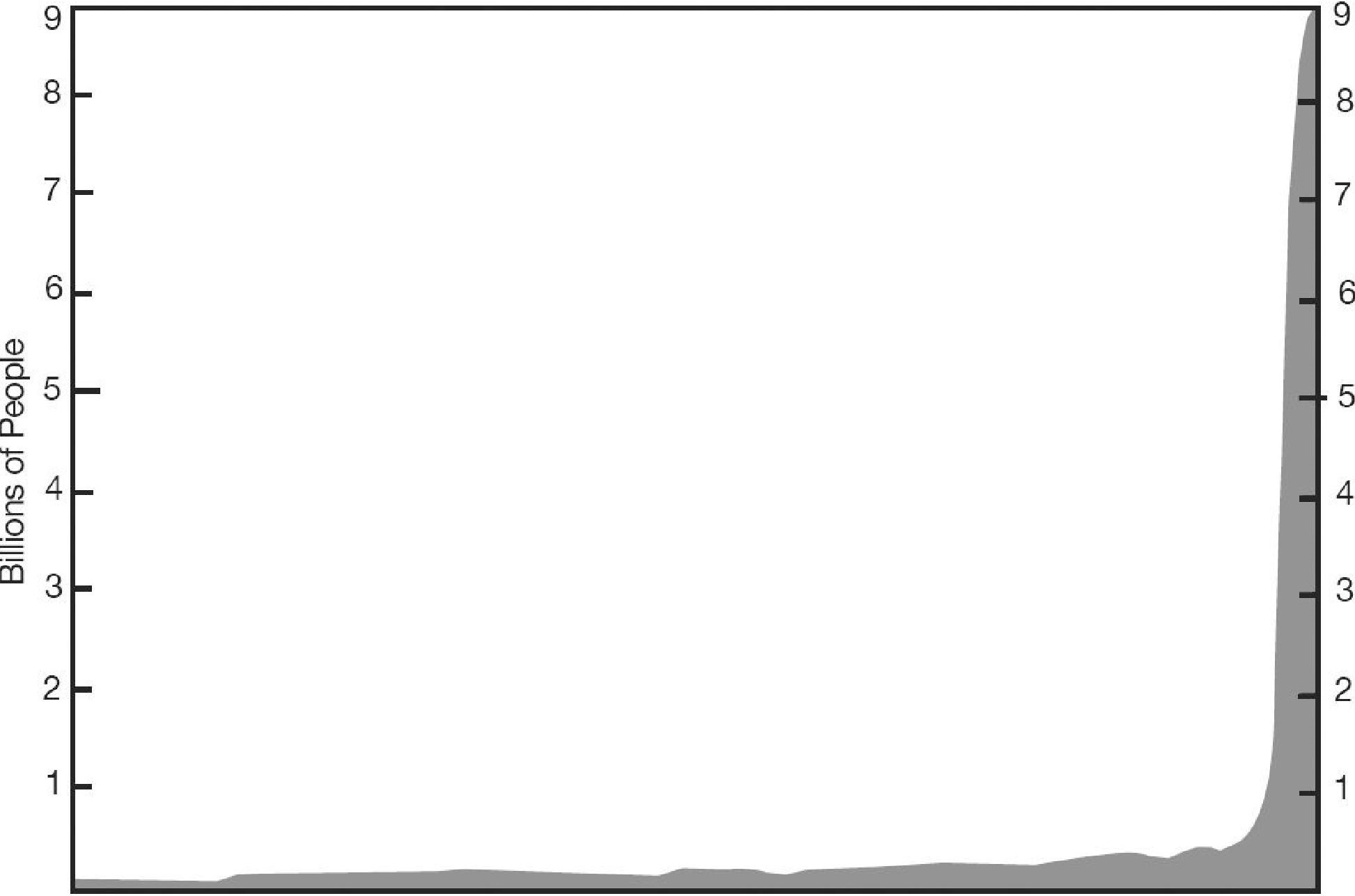
2-5 million 7000 6000 5000 4000 3000 2000 1000 1 1000 2050
years BC BC BC BC BC BC BC AD AD AD
A heavy silence settled in the room.
“Yes,” the lanky man finally said. “Silent terror is an apt response to this graph. Seeing it is a bit like staring into the headlight of an oncoming locomotive.” Slowly, the man turned to Elizabeth and gave her a tight, condescending smile. “Any questions, Dr. Sinskey?”
“Just one,” she fired back. “Did you bring me here to lecture me or insult me?”
“Neither.” His voice turned eerily cajoling. “I brought you here to work with you. I have no doubt you understand that overpopulation is a health issue. But what I fear you don’t understand is that it will affect the very soul of man. Under the stress of overpopulation, those who have never considered stealing will become thieves to feed their families. Those who have never considered killing will kill to provide for their young. All of Dante’s deadly sins—greed, gluttony, treachery, murder, and the rest—will begin percolating … rising up to the surface of humanity, amplified by our evaporating comforts. We are facing a battle for the very soul of man.”
“I’m a biologist. I save lives … not souls.”
“Well, I can assure you that saving lives will become increasingly difficult in the coming years. Overpopulation breeds far more than spiritual discontent. There is a passage in Machiavelli—”
“Yes,” she interrupted, reciting her recollection of the famous quote. “ ‘When every province of the world so teems with inhabitants that they can neither subsist where they are nor remove themselves elsewhere . the world will purge itself.’ ” She stared up at him. “All of us at the WHO are familiar with that quotation.”
“Good, then you know that Machiavelli went on to talk about plagues as the world’s natural way of self-purging.”
“Yes, and as I mentioned in my talk, we are well aware of the direct correlation between population density and the likelihood of wide-scale epidemics, but we are constantly devising new detection and treatment methods. The WHO remains confident that we can prevent future pandemics.”
“That’s a pity.”
Elizabeth stared in disbelief. “I beg your pardon?!”
“Dr. Sinskey,” the man said with a strange laugh, “you talk about controlling epidemics as if it’s a good thing.”
She gaped up at the man in mute disbelief.
“There you have it,” the lanky man declared, sounding like an attorney resting his case. “Here I stand with the head of the World Health Organization—the best the WHO has to offer. A terrifying thought if you consider it. I have shown you this image of impending misery.” He refreshed the screen, again displaying the image of the bodies. “I have reminded you of the awesome power of unchecked population growth.” He pointed to his small stack of paper. “I have enlightened you about the fact that we are on the brink of a spiritual collapse.” He paused and turned directly toward her. “And your response? Free condoms in Africa.” The man gave a derisive sneer. “This is like swinging a flyswatter at an incoming asteroid. The time bomb is no longer ticking. It has already gone off, and without drastic measures, exponential mathematics will become your new God … and ‘He’ is a vengeful God. He will bring to you Dante’s vision of hell right outside on Park Avenue . huddled masses wallowing in their own excrement. A global culling orchestrated by Nature herself.”
“Is that so?” Elizabeth snapped. “So tell me, in your vision of a sustainable future, what is the ideal population of earth? What is the magic number at which humankind can hope to sustain itself indefinitely . and in relative comfort?”
The tall man smiled, clearly appreciating the question. “Any environmental biologist or statistician will tell you that humankind’s best chance of long-term survival occurs with a global population of around four billion.”
“Four billion?” Elizabeth fired back. “We’re at seven billion now, so it’s a little late for that.”
The tall man’s green eyes flashed fire. “Is it?”